Thursday, May 11, 2006

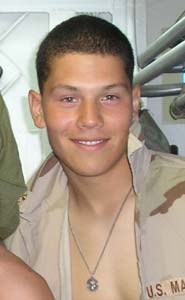
RIP Sgt. Jose Gomez

If you can, please help the families of the fallen. They need us.
May peace be inside all of us


Maria Gomez, center, mother of Sgt. Jose Gomez, is helped by her husband Felix Jimenez, right, at her son's casket during his funeral service, Wednesday, May 10, 2006, in New York. Gomez died in Baghdad on April 28, 2006 when a roadside bomb detonated near his Humvee. The soldier was assigned to the 10th Cavalry, 4th Brigade, 4th Infantry Division, Fort Hood, Texas. (AP Photo/Mary Altaffer)


Marie Canario , center, fiancee of Sgt. Jose Gomez, is helped is helped by mourners as she places roses on the casket during his funeral service, Wednesday, May 10, 2006 in New York. Gomez died in Baghdad on April 28, 2006 when a roadside bomb detonated near his Humvee. The soldier was assigned to the 10th Cavalry, 4th Brigade, 4th Infantry Division, Fort Hood, Texas. (AP Photo/Mary Altaffer)


Sgt. Major Chris Rodriguez pays his final repects to Sgt. Jose Gomez during his funeral service, Wednesday, May 10, 2006, in New York. Gomez died in Baghdad on April 28, 2006 when a roadside bomb detonated near his Humvee. The soldier was assigned to the 10th Cavalry, 4th Brigade, 4th Infantry Division, Fort Hood, Texas. (AP Photo/Mary Altaffer)


Patriot Guard Riders vincent Cerroni, right, Bob Keplers, center and Phil Donahue salute as honor guard soldiers carry Sgt. Jose Gomez's casket to his funeral service at Our Lady of Sorrows Church, Wednesday, May 10, 2006 in New York. Gomez died in Baghdad on April 28, 2006 when a roadside bomb detonated near his Humvee. The soldier was assigned to the 10th Cavalry, 4th Brigade, 4th Infantry Division, Fort Hood, Texas. (AP Photo/Mary Altaffer)

STONE-COLD EVIDENCE THAT BUSH STOLE THE VOTE IN 2004 AGAIN.

It's up to everyone of us to work in our own town, in our own cities to make sure our votes are counted this time. Do you want to keep paying your taxes without having a say what goes on in our government? If we would have stood up and demanded they count our votes, so many people would be alive today. We have killed and tortured so many people. The worst part is our children will have to live in this world we have created for them. They will have to fix the mess we made. Are we teaching them how to fix the mess we can't fix ourselves?
2 more weeks left of school Today is "dress like the 50's day"for teacher appreciation week. Remember how we trusted in the 50's? Well, I wasn't born until 62 but, we had trust back then. Trust we were getting our votes counted.

May peace be inside all of us,
Cindy


************************************

CRANKS AND KOOKS: KERRY WON IN '04 ... HEAR ONE OF THEM--LARRY DAVID--TELL YOU THE STONE-COLD EVIDENCE THAT, YEP, GEORGE BUSH STOLE IT IN 2004. AGAIN.

From Armed Madhouse, the new book by Greg Palast
Wednesday, May 10, 2006

Hear Larry David, auteur of HBO's "Curb Your Enthusiasm," and principal
writer of the "Seinfeld" series reading Palast's new book, Armed
Madhouse, Chapter 4: The Con-Kerry Won at www.GregPalast.com

Read the excerpt here:

THE CON

Kerry Won. Now Get Over It . . .

...because they're putting '08 in their pocket. Republicans just seem
to have that winning spirit. They also have caging lists, felons of the
future, rotting ballots, snuffed canaries, and a lock on the votes of
Kissinger-Americans and the undead.

WARNING! There are cranks and kooks and crazies out there on the
Internet who say that George Bush lost the 2004 election, like one titled,
"Kerry Won" published on the TomPaine.com web site two days after the
election. I wrote it.

On November 11, a week after TomPaine.com published it, I received an
e-mail from The New York Times Washington Bureau. Hot on the
investigation of the veracity of the vote, The Times reporter asked me pointed
questions:

Question #1: Are you a "sore loser"?

Question #2: Are you a "conspiracy nut"?

There was no third question. Investigation of the vote was, for The
Times at any rate, complete. The next day, the paper's thorough analysis
of the evidence yielded this front-page story, "VOTE FRAUD THEORIES,
SPREAD BY BLOGS, ARE QUICKLY BURIED."

As America's self-proclaimed Paper of Record had no space for the
facts, I thought I'd share some with you here.

"Kerry Won" was not a two-day inquiry à la Times. It was the latest in
a series of investigative reports coming out of a four-year team
examination, begun for BBC Television's Newsnight, Britain's Guardian papers
and Harper's Magazine, dissecting that greasy sausage called American
electoral democracy.

And, by the way, the answer to Question #1: I didn't lose, so I'm not
sore. This investigation isn't about John Kerry. As a journalist, I
don't give a toss which rich white kid won the game. But I'm not so blasé
that I don't care about the disappearance of American democracy. And I
really wanted to know how the Bushes swallowed the sausage.

How'd they do it? Again. And how will they do it in '08? The answer
arrived just after midnight on October 8, 2004, three weeks before the
official voting, in a series of extraordinary e-mails. The e-mails were
intended for the chieftains of the President's re-election campaign in
Washington. Strangely enough, they were misaddressed and ended up in my
mailbox. Such things happen.

NIGHT OF THE UNCOUNTED:
How to Disappear Three Million Votes

But the e-mails and their technical attachments won't mean a thing
unless you understand some arcane facts about elections American-style.

First, consider CNN's Ohio exit polls broadcast just after midnight
after the voting ended on Election Day. They show John Kerry defeated
George Bush among women voters by 53% to 47%. And among men voters, Kerry
defeated Bush 51% to 49%.

So here's your question, class: What third sex put George Bush over the
top in Ohio and gave him the White House?

Answer: The Uncounted.

In Ohio, there were 153,237 ballots simply thrown away, more than the
Bush "victory" margin. In New Mexico the uncounted vote was fives times
the Bush alleged victory margin of 5,988. In Iowa, Bush's triumph of
13,498 was overwhelmed by 36,811 votes rejected. In all, over three
million votes were cast but never counted in the 2004 presidential election.
The official number is bad enough-1,855,827 ballots cast not counted,
reported to the federal government's Election's Assistance Commission.
But the feds are missing data from several cities and entire states too
embarrassed to report the votes they failed to count. Correcting for
the under-reporting of the undercount, the number of ballots cast but
never counted goes to 3,600,380. And there are certainly more we couldn't
locate to tote up.

Why doesn't your government tell you this? Hey, they do. It's right
there in black-and-white on a U.S. Census Bureau announcement released
seven months after the election -- in a footnote to the report on voter
turn -- out. The Census tabulation of voters voting "differs," from
ballots tallied by the Clerk of the House of Representatives for the 2004
presidential race by 3.4 million votes.

This is the hidden presidential count which, excepting the Census'
whispered footnote, has not been reported.

Unfortunately, that's not all. In addition to the 3 million ballots
uncounted due to technical "glitches," millions more were lost because the
voters were prevented from casting their ballots in the first place.
This group of un-votes includes voters illegally denied registration or
wrongly purged from the registries.

In the voting biz, most of these lost votes are called "spoilage."
Spoilage, not the voters, picked our president for us.

Joe Stalin, the story goes, said, "It's not the people who vote that
count; it's the people who count the votes." That may have been true in
the old Soviet Union, but in the U.S.A, the game is much, much subtler:
He who makes sure votes don't get counted decides our winners.

In the lead-up to the 2004 race, millions of Americans were, not
unreasonably, panicked about computer voting machines, "black boxes," that
could flip your vote from John Kerry to George Bush. Images abounded of
an evil hacker-genius in Dick Cheney's bunker rewriting code and zapping
the totals. But that's not how it went down. The computer scare was the
McGuffin, the fake detail used by magicians to keep your eye off their
hands. The new black boxes played their role, albeit minor, but the
principal means of the election heist-voiding ballots, overwhelmingly of
the poor and Black-went unexposed, unreported and most importantly,
uncorrected and ready to roll out on a grander scale in 2008.

I went to sleep election night with the exit polls showing Kerry ahead
in swing states. But between 1:05 am and 6:41 am the next morning,
goblins went to work. By dawn, the network's exit poll for Ohio showed
Kerry dead even with Bush among women, and down by five percentage points
among men.

What happened? Were thousands of Bush voters locked in the voting
booths, released at 2am, then queried about their choices? Not quite. The
network's polling company applied a fancy "algorithm," a mathematical
magic wand, to slowly transform the exit polls to match the official
count.

And that's bad. By deliberately contaminating the exit polls, the
networks snuffed the canary that would signal that something was deeply
wrong about the vote count.

Hunting for a Democrat to defend the Twilight Zone between the exit
polls and the "official" polls, media grabbed on Dick Morris, Bill
Clinton's old advisor. An expert at walking that fine line between minor
criminality and psychopathic ambition, Morris knows which way his next
client's wind blows.

Morris said:

"Exit polls are almost never wrong. So reliable are the surveys that
actually tap voters as they leave the polling places that they're used as
guides to the relative honesty of elections in Third World Countries.
To screw up one exit poll is unheard of. To miss six of them is
incredible."

His opening was promising, but then he switches into full Morris:
"It boggles the imagination how pollsters could be that incompetent and
invites speculation that more than honest error was at play here."

So, Dick, you're telling us there was an evil cabal among six
pollsters, competitors who don't even like each other, conspiring one dark night
to make George Bush look like a vote thief.

There's another explanation: Kerry won.

We've got the body (the wounded elections), we've got the bullet holes
(the missing votes), now where are the smoking guns? How does the GOP
disappear the vote? And why do Democratic ballots spoil so much more
readily than Republican ballots? How's it done?

But that little Bill O'Reilly in your head is screaming, Get over it;
let's move on already. What they tested in 2000 and practiced in 2004,
they are preparing to roll out in 2008 big time.

----

Get the rest of the nasty truth about the election of 2004 and the
program to steal '08 -- from Republican "caging lists," the "disappearing
Democrats of Area 51," 50 illustrations and even weirder stuff in ARMED
MADHOUSE: WHOSE AFRAID OF OSAMA WOLF?, CHINA FLOATS BUSH SINKS, THE
SCHEME TO STEAL 2008, NO CHILD'S BEHIND LEFT AND OTHER DISPATCHES FROM THE
FRONT LINES OF THE CLASS WAR, Greg Palast's newest exposé of war, oil,
elections and class.

Or get the 5 CD ARMED MADHOUSE audio book: Read by Larry David, Randi
Rhodes, Janeane Garofalo, Randy Credico, Brad Friedman, Mark Crispin
Miller, Jerry Quickley , Amy Goodman, Ed Asner, Brod Bagert, Medea
Benjamin, Kevin Danaher, Jim Hightower, and Shiva Rose.

"No one has uncovered more about the Bush Dynasty than Greg Palast ...
and lived to write about it." - Baltimore Chronicle

Wednesday, May 10, 2006

My Friends Carlos Arredondo and Cindy Sheehan - The Truth Force of Sorrow


Published on Sunday, May 7, 2006 by CommonDreams.org
The Truth Force of Sorrow
by Susan Van Haitsma

My neighbor, who is almost five, is one of my greatest teachers. For most of his life, we've shared weekly play dates, and I cherish this window he gives me into the fascinating, focused mind of a child living in the very present moment.

Lately, my little neighbor has been exploring the realm of weapons and combat. Following the lead of his parents, whose wisdom I trust and admire without reservation, I tend to go with the flow when he sets the stage for our imaginary battle scenarios.

Our war play provides interesting opportunities to experiment with various responses to violence. Generally, when my young friend asks me or the 'bad guy' Lego or Playmobile characters I represent to take up weapons against his 'good guy' characters, I suggest alternative means of engagement. Are his guys hungry? Would they join my guys for lunch? Gradually, we find that the weapons and armor we or the characters are toting around impede doing things like eating imaginary lunches, and often by the time we are done playing, the weapons have been discarded due to impracticality.

Sometimes, however, his characters simply kill my characters. During our most recent play session, my surviving character said that he wanted to be alone for a minute because he was sad that his friends were dead. My young neighbor, who of course is wise to my motives, replied, "Susan, there's no sad in this game."

Soldiers themselves, those who have "skin in the game," often use the same metaphor for war, according to my veteran friends.

"Just play the game," they tell each other - a game in which sadness and stress are supposed to be denied. When my preschool friend disengaged from the imaginary world for a moment to clarify the rules, he indicated his ability to distinguish between real and pretend. Real soldiers must live in the real world, however, and when they make a game of it out of emotional necessity or peer pressure, they suffer. When politicians make a game of war, the soldier suffers further.

Because real war is not a game, the revelation of war's costs and consequences cannot be declared against the rules. Yet US government leaders disregard or deny even the most basic human consequence as sadness, as though they have the power to will it into non-existence. In the meantime, the excruciating painfulness of war has found powerful expression through soldiers' family members, military veterans and many allied international witnesses to war such as Women in Black and CodePink.

Recently, several members of Military Families Speak Out visited Austin following an Easter vigil at Camp Casey in Crawford, Texas. Cindy Sheehan mentioned the loneliness and pain she continues to feel even while surrounded by friends and supporters. I could see the evidence in her eyes when we spoke briefly following her presentation.

I also met Carlos Arredondo, a native of Costa Rica whose harrowing story concerning the death of his eldest son was not shared entirely from the stage, but in a few words he shared with people afterward as they were leaving. "Look here, at my scars, where I was burned," he said, lifting his shirt to show where, in a panic of distress, he had set himself on fire after climbing into the Marine van that had just arrived carrying the news about his 20 year-old son, Alex. It had been Carlos' birthday, and his initial thought when the van pulled up was that Alex was making a surprise visit home from Iraq to help him celebrate.

Later, in an article by Eugene Richards in The Nation, I learned more of Arredondo's story. As parents of dead soldiers often report, the pain and sorrow usually is felt long before the moment they are informed of their child's death. "I see all the sadness, see how they kill, see how the Marines move through dark alleyways, kick doors, blindfold people, while afraid most of the time for snipers and bombs," Arredondo said, referring to his distress when Alex was deployed to the Middle East over a year before his death. "It was too much, too much, too much for parents."

For parents like Cindy Sheehan, Carlos Arredondo, and other members of Gold Star Families for Peace, sorrow has propelled them to action. When Arredondo spoke in Austin, he carried a poster-sized photograph of his uniformed son lying in his casket. As one of only a few Gold Star parents who have been able to arrange for open caskets, he felt it was important to share the image, which he held aloft when he and other members of MFSO spoke to the press and the public. A warm, intense man who, like Sheehan, was quick to thank and embrace those who attended their presentation, Arredondo has channeled his sorrow into an outward expression of care for others, so that they will not have to endure what he has. As Sheehan often has noted, grief also can increase fearlessness. "I know how to say 'Impeach' in two languages," said Arredondo, firmly.

Sorrow is the natural response to death, and, as my young neighbor seems to know instinctively, the full expression of sadness may be war's most natural and effective deterrent. As Gandhi demonstrated by fasting and taking on suffering as a response to killing, sorrow is a truth force that says, "This is what war feels like." To a populace whose national directive stresses the pursuit of happiness, sorrow is an important obstacle to business as usual.

On Mother's Day weekend, many events are planned to express the acute sadness caused by invasion, war and occupation, with a special emphasis on the huge human cost to families of the dead. In the large scheme of things, we are all family, and the cost has been too much, too much, too much.


Why Myspace.com is making the news

Thanks Jesse for telling me about so many things other people won't tell you. I love getting your email everyday.

If you don't know who Jesse is go visit his site here
Join his email. It's the best.

May peace be inside all of us,
Cindy

TVNL Editor's Comments: Myspace.com – Suddenly Newsworthy – Do you know Why?

Have you noticed that Myspace.com has been getting a lot of attention lately? Internet predator and potential school massacre “news: stories” seem to involved Myspace.com quite often lately. You know there are millions of websites and Internet communities but these sensational news stories suddenly seem to focus on those devilish people who leave a criminal trail on Myspace.com.

Well, have you ever heard the _expression “the only bad publicity is no publicity?” Whenever these stories hit the networks you can bet millions of people are scrambling over to their computers to check out Myspace.com. You can even bet that these news stories are attracting more pedophiles and such over to join up; after all other predators are meeting their victims on that site and the news networks are helping to spread the word to any pedophiles who have not heard of the site. Business is business.

Well if you ask my why all this new attention is being paid to Myspace.com it is because Rupert Murdoch just forked over a half a billion dollars (actually $580 billion) to buy Myspace.com and he is doing everything he can to get publicity for his new media venture. That’s right; I think that the owner of FOX News has his pals at all the networks promoting his business. Well, you have to wonder why all of a sudden this site is making headlines. It is not new web site; it was only newly purchased…by a media mogul. Come on, do the math…out of all the websites in the world Myspace.com became the focus of the news networks; is it merely a coincidence that this happened after the owner of a few networks bought it? Think about it! – Jesse, Editor, TvNewsLIES.org

Tuesday, May 09, 2006

Bush in South Florida - protested everywhere he goes


Protesters rally outside private fund-raiser attended by Bush

By Kelli Kennedy / Associated Press

FORT LAUDERDALE, Fla. - About 50 people gathered outside a gated community to protest the Bush administration and Iraq war Monday, as President Bush arrived for a private fund-raiser.

Bush was to attend the fund-raiser for Republican Rep. Clay Shaw who is running against Democratic Sen. Ron Klein in the 22nd Congressional District - a seat that has statewide significance for both parties. It was to be held at a lagoon-side mansion owned by Mike Maroone, president and chief operating officer of AutoNation Inc., the largest U.S. auto retailer.

Protesters held signs that said "Stop oil addiction" and "Hands off my civil rights," while chanting "No blood for oil," as the president's motorcade rolled up around 5:10 p.m.

"We're extremely concerned that this war has turned into another Vietnam," said protest organizer Kathleen Healey, 45, of Fort Lauderdale.

A handful of teenagers also turned out for the event, shouting anti-war slogans over a microphone.

Nikki Boortz, 17, and her brother, Ty, 14, drove from Boca Raton.

"I don't think it's fair. I don't like how so many Iraqi civilians and children are dying," Nikki Boortz said.

Dressed in wide brim straw hats and floral aprons, a group from the Raging Grannies said Bush was also in town to promote a prescription drug care plan.

The president is to appear at Broward Community College's North Campus in Coconut Creek Tuesday morning for a Medicare prescription drug benefit enrollment.

"It's an attempt to get his toe in the door to privatize Medicare and Social Security," said Mary Jane Mullins, 75, of Deerfield Beach. "All of this country is being sold to corporate interests."

Lauren Fabian brought her two young children to the demonstration. Her three-year-old daughter Sasha has already been asking about the Iraq war.

"I told her a lot of the children there were getting hurt," said Fabian, 36, of Fort Lauderdale. "I want to teach my children to question things."

When asked what her tiny "No War" sign meant, Sasha said simply, "Peace."

Monday, May 08, 2006

Mothers Day in DC - A request from a friend, wishing I could go.

Hello - I am asking a request of you all. Please join us in DC for this event.

If you knew Alex or any of the troops who were killed in Iraq, if you have shed a tear over the loss of life, if you want to honor our troops, YOU SHOULD BE THERE! This is a family event. Please bring your kids. This is not a "rah, rah / yea peace event". This event will contemplative and powerful. For further questions, contact me or the email listed below. If you are not pleased that I have sent you this email, please try to comprehend that I am sending this email out to have you as many people unite to honor Alex. Memorial Day will be a few days later. There are many purposes of this march, one of which is to have so many who are uncncerned TO WAKE UP! THE WAR IS NOT A VIDEO GAME OR REALITY TV FOR ENTERTAINMENT.
Melida Arredondo

A call to take part in
Silence of the Dead, Voices of the Living:
A Witness to End the War in Iraq


May 11-14, 2006
at the National Mall in Washington, D.C.

and across the United States On Mother’s Day weekend, you are invited to join members and supporters of the American Friends Service Committee, Gold Star Families for Peace, Gold Star Families Speak Out, Iraq Veterans Against the War, Military Families Speak Out, September 11th Families for Peaceful Tomorrows, and Veterans for Peace, who will gather for four days of witness in Washington, D.C. (and in sites around the country) to call for an end to the Iraq War. We will mourn for the thousands who have been lost and call for an end to the war that continues to take Iraqi, U.S. and other lives.

Led by many of those who have borne the cost of the war, silent marchers will carry boots representing those who have died and photos of those still in harm’s way -- calling on Congress to save lives by stopping the war. Participants will include: veterans; families of the U.S. soldiers who have been killed and wounded; families of those on active duty who remain in harm’s way; families of those who died in the attacks on September 11th in whose name the Iraq War was started, and representatives of the people of Iraq, who have seen more than 100,000 deaths and the destruction of their country. Eyes Wide Open: The Human Cost of the Iraq War, the American Friends Service Committee’s touring exhibit (eyes.afsc.org) that honors the lives lost in Iraq will return to Washington, D.C. for these days of witness, with combat boots representing the deaths of U.S. military personnel, a striking new representation of Iraqi losses, and symbols of the lives that will most certainly be lost before the end of 2006, if the U.S. “stays the course.” The exhibit will provide a dramatic visual backdrop for the words and emotions of those who have lost the most in this conflict – and stand to lose more. Please come and take part in: the set up and staffing of the Eyes Wide Open exhibit; a daily reading of names of U.S. service personnel and Iraqis killed in the war; a silent memorial procession around the Mall; testimonies from those who have lost loved ones and from those whose loved ones remain in harm’s way; a candlelight vigil; and other events.
For more information, contact: Chris Pifer, AFSC Washington Office
eyesvol@afsc.org Interested in volunteering

Friday, May 05, 2006

Do you know how many today?

2,414 so we are told


3 U.S. Soldiers Killed in Iraq Bombing

By Sinan Salaheddin / Associated Press

BAGHDAD, Iraq - A roadside bomb killed three American soldiers south of Baghdad on Friday as U.S. and Iraqi forces swept through a city to the north where three insurgents had been killed the day before after firing on U.S troops.

The three Americans died in the attack shortly before noon in Babil province, the U.S. military said, giving few other details. However, Iraqi police said the blast targeted a military convoy near Mahaweel, 35 miles south of Baghdad.

In Samarra, 60 miles north of the capital, American and Iraqi forces imposed a daytime curfew and searched neighborhoods looking for insurgents a day after three militants were killed after they opened fire on U.S. soldiers, police said.

Samarra was the scene of the Feb. 22 explosion at a Shiite shrine that enflamed sectarian tensions. It triggered reprisal attacks on Sunnis, forced tens of thousands of Iraqis to flee their homes and pushed the country to the brink of civil war.

American officials are hoping the new national unity government of Shiites, Sunnis and Kurds will eventually reduce sectarian tensions and lure disaffected Sunni Arabs away from the insurgency so U.S. and other foreign troops can begin to go home.

Prime Minister Nouri al-Maliki has until late this month to complete his Cabinet, the final stage in organizing the new government. Haitham al-Husseini, a Shiite spokesman, said the Cabinet would be announced Tuesday.

The statement was made after a meeting among al-Maliki, President Jalal Talabani, a Kurd, and two top Shiite leaders. No Sunni Arabs politicians attended, and it was unclear whether the Sunnis had accepted the Tuesday date.

In a joint interview Friday with Al-Arabiya television, Foreign Minister Hoshyar Zebari, a Kurd, and Sunni Arab lawmaker Saleh al-Mutlaq clashed over whether the Kurds should retain the Foreign Ministry post.

Zebari, who has headed the ministry since 2003, said the Kurds deserved the ministry "due to our long struggle" against Saddam Hussein's regime.

Al-Mutlaq described the talk of an impending Cabinet announcement "as a sword over our neck" and complained about the system of allocating top posts along religious or ethnic lines.

Six people, five of them Sunnis, were killed Friday when gunmen in three cars shot up and firebombed two small groceries in the capital's Yarmouk district, police said. A community leader was slain by gunmen near Khalis 50 miles north of Baghdad, police said.

An Iraqi police major was assassinated in a drive-by shooting in Diwaniyah, 80 miles south of Baghdad, police said. And a Shiite cleric, Hussein Ahmed al-Mousawi, was shot and killed near his home in Baghdad's Dora district, according to police Capt. Jamil Hussein.

The bodies of eight Iraqis who apparently were kidnapped and killed also were found Friday, four in Baghdad and one on the outskirts of the city, police said. Such sectarian killings by Shiite and Sunni "death squads" have become common in Iraq, especially in the capital.

The attack on the Americans raised to at least 2,414 the number of U.S. military members who have died since the Iraq war started in March 2003, according to an Associated Press count.

Elsewhere, gunmen kidnapped seven employees of the state-run company that operates oil fields in northern Iraq, police said. The workers were traveling by minibus to the refinery in Beiji when they were stopped by gunmen about 25 miles southwest of Kirkuk.

Security problems in the Kirkuk area, including attacks on pipelines, have hindered Iraq's ability to exploit the vast potential of the northern oil fields. Nearly all of Iraq's oil exports — averaging less than 2 million barrels a day — have come from the southern fields around Basra.

**********************************

March 2004
My Thoughts Drift Away.....
It's a beautiful day,The lawn fills with smiling faces.
The sounds of years past delight my ears.
Dancing and singing and enjoying the day.
I look to the sky, my thoughts drift away.
How many will die today?

I think of all those who live in fear,
as I listen to the music and enjoy my beer.
Enjoying the day with all the smiling faces.
Do they know how many will die today?
While they partake the sounds of the past.
I look at their faces and realize they do not.
I mention to a friend my thoughts.

With tears running down, I look at the ground.
I pray for the souls that will be set free.
I pray for the mothers and fathers.
I pray for the brothers and sisters,
for the husbands and wives,
and for the daughters and sons.
All will have to live without their loved ones.

I try to enjoy the moment once more, but I cannot.
My soul cry's for all the death we have caused.
I pray for peace in all humans that we can enjoy our moments.
Precious moments we choose to blow away, forever.

By, MomFromHlwdFL

Judge on Internet Wiretap "government's courtroom arguments were "gobbledygook."


Judges Challenge Internet Wiretap Rules

By TED BRIDIS, Associated Press Writer

A U.S. appeals panel sharply challenged the Bush administration Friday over new rules making it easier for police and the FBI to wiretap Internet phone calls. A judge said the government's courtroom arguments were "gobbledygook."

The skepticism expressed so openly toward the administration's case encouraged civil liberties and education groups that argued that the U.S. is improperly applying telephone-era rules to a new generation of Internet services.

"Your argument makes no sense," U.S. Circuit Judge Harry T. Edwards told the lawyer for the Federal Communications Commission, Jacob Lewis. "When you go back to the office, have a big chuckle. I'm not missing this. This is ridiculous. Counsel!"

At another point in the hearing, Edwards told the FCC's lawyer that his arguments were "gobbledygook" and "nonsense."

The court's decision was expected within several months.

In an unrelated case last year affecting digital television, two of the same three judges determined the FCC had significantly exceeded its authority and threw out new government rules requiring anti-piracy devices in new video devices. Lewis was also the losing lawyer in that case, and Edwards also was impassioned then in his criticisms of the FCC.

In the current case, Edwards appeared especially skeptical over the FCC's decision to require that providers of Internet phone service and broadband services must ensure their equipment can accommodate police wiretaps under the 1994 Communications Assistance for Law Enforcement Act, known as CALEA.

The new rules go into effect in May 2007.

The 1994 law was originally aimed at ensuring court-ordered wiretaps could be placed on wireless phones.

The Justice Department, which has lobbied aggressively on the subject, warned in court papers that failure to expand the wiretap requirements to the fast-growing Internet phone industry "could effectively provide a surveillance safe haven for criminals and terrorists who make use of new communications services."

Critics said the new FCC rules are too broad and inconsistent with the intent of Congress when it passed the 1994 surveillance law, which excluded categories of companies described as information services.

The FCC asserted that providers of high-speed Internet services should be covered under the 1994 law because their voice-transmission services can be considered separately from information services. "Congress intended to cover services (in the 1994 law) that were functionally equivalent" to traditional telephones, Lewis said during the hearing in U.S. Circuit Court for the District of Columbia.

"There's nothing to suggest that in the statute," Edwards replied. "Stating that doesn't make it so."

The panel appeared more inclined to support the FCC's argument that Internet-phone services — which allow users to dial and receive calls from traditional phone numbers — may be covered under the 1994 law and required to accommodate court-ordered wiretaps. The technology, popularized by Holmdel, N.J.-based Vonage Holdings Corp., is known as "voice over Internet protocol," or VOIP.

"Voice-over is a very different thing," U.S. Circuit Judge David B. Sentelle said. He said it offered "precisely the same" functions as traditional telephone lines.

Edwards told the lawyer for the civil liberties groups, Matthew Brill, that on his challenge that VOIP services aren't covered under the surveillance law, "I didn't think you have it."

Education groups had challenged the FCC rules because they said the requirements would impose burdensome new costs on private university networks.

The third judge on the panel, Janice Rogers Brown, did not comment or ask any questions during the arguments.

Thursday, May 04, 2006

Stop the TORTURE being done in my name STOP IT NOW!


Report blames top U.S. officials for alleged torture of detainees

By Matthew Schofield / Knight Ridder

BERLIN - Torture and other cruel, inhuman or degrading treatment of detainees by U.S. forces is widespread and, in many cases, sanctioned by top government officials, Amnesty International charged Wednesday.

The allegations, contained in a 32,000-word report released in New York and London and posted on the human rights organization's Web site, are likely to influence a U.N. hearing on U.S. compliance with international torture agreements that begins Friday in Geneva. Amnesty International sent a copy of the report to the U.N. Committee Against Torture, which is holding the hearings.

"Although the U.S. government continues to assert its condemnation of torture and ill-treatment, these statements contradict what is happening in practice," said Curt Goering, the group's senior deputy executive director in the United States. "The U.S. government is not only failing to take steps to eradicate torture, it is actually creating a climate in which torture and other ill-treatment can flourish."

American officials denied the allegations. "There's no more staunch defender of human rights around the world than the United States government," State Department spokesman Sean McCormack said.

A Pentagon spokesman, Lt. Col. Mark Ballesteros, said "humane treatment of detainees is and always has been the (Defense Department) standard." He noted that a dozen reviews of military detention operations had found no evidence that the top officials encouraged abuse.

The report notes that American military officials have listed 34 deaths of detainees in U.S. custody as "confirmed or suspected criminal homicides." It suggested that the true number may be much higher, saying "there is evidence that delays, cover-ups and deficiencies in investigations have hampered the collection of evidence."

"In several cases," it says, "substantial evidence has emerged that detainees were tortured to death while under interrogation. . . . What is even more disturbing is that standard practices as well as interrogation techniques believed to have fallen within officially sanctioned parameters, appear to have played a role in the ill-treatment."

The Amnesty International report was a foretaste of the hearing in Geneva, scheduled for Friday and Monday.

The United States is dispatching a delegation of 30 officials to testify at the hearing, which is a follow-up to a review in 2000 that was critical of America's treatment of inmates in its domestic prisons.

The hearing is expected to focus on the allegations of mistreatment of prisoners taken captive in the wars in Afghanistan and Iraq or seized by U.S. agents in other countries and later jailed at the American naval base at Guantanamo Bay, Cuba, or at undisclosed locations.

The United States is one of seven nations the committee is reviewing during meetings this month. The others are Georgia, Guatemala, Peru, Qatar, South Korea and Togo.

The United States is one of more than 140 nations that have approved the convention against torture. The U.S. has written to the committee saying it's unequivocally opposed to torture.

The Amnesty International report questions that, saying there's evidence that top American officials had approved abusive interrogation techniques.

"Most of the torture and ill-treatment stemmed directly from officially sanctioned procedures and policies, including interrogation techniques approved by Secretary of Defense Donald Rumsfeld," said Javier Zuniga, Amnesty International's Americas director.

The report criticizes the United States for giving those convicted of abuse relatively light sentences.

"The heaviest sentence imposed on anyone to date for a torture-related death while in U.S. custody is five months, the same sentence that you might receive in the U.S. for stealing a bicycle," Goering said. "In this case, the five-month sentence was for assaulting a 22-year-old taxi driver who was hooded and chained to a ceiling while being kicked and beaten until he died."


Pro-America = Anti-BushCo by Cindy Sheehan


Pro-American = Anti-BushCo

By Cindy Sheehan

I (and every single other individual on this planet working for peace and justice) am often accused of being "anti-American" for dissenting against my feral government that has gone wild with lawlessness and greed; even though dissent from our government is as American as apple pie. Some people believe that if one is critical of the Bush criminal regime, then one is anti-American.

I steadfastly believe that to be anti-BushCo means being pro-American; pro-life; and most of all: pro-peace.

In a recent article in the Boston Globe (Sun, April 30) the Bush regime is blamed for breaking or giving itself permission to break over 750 laws. George is the only sitting president to have admitted to breaking laws and for openly disdaining the constitution as an "old scrap of paper." How can we peaceniks be accused of being anti-American when the squatter in the Oval Office has no respect for the supreme law of the land? But of course, 9/11 changed the world and we are a nation "at war" so George thinks he can do whatever he wants even though he is the one who made us a nation at war with his lies and deceptions. I will stipulate that the constitution is a deeply flawed document, but the founders realized this and gave we future generations ways to amend it and one of the ways to amend it is not just "cuz the president says so." He may be the decider but he is not the amender.

Extreme rendition and torture are being authorized from the top and carried out in the name of the American people. A recent Amnesty International report calls torture "widespread" for people in US captivity. CIA trained black operatives have even bragged how inhuman and brutal that water-boarding is and gave a high level terrorist his persecution props for being able to last over two minutes. In this particularly lovely form of torture, a person has cellophane wrapped around his mouth and nose and tipped at an angle so water pours over his face--thus creating the feeling of drowning--so to avoid choking, the prisoner succumbs. Our own torturers, who have to go through the ropes, can last for only a few seconds in this torture. Add the sexual depravation practiced on the prisoners with the tormenting of some prisoners by flushing the Koran and so forth: then not only is the humanity of the tortured broken, but the torturer also becomes lower than an animal. I used to watch a lot of Animal Planet but I have never seen nor heard of a four legged creature torturing another four legged creature. However, as long as we Americans condone this behavior from the ones who authorize such viciousness from the top, we are the torturers also. We become the thing that we abhor.

George, Condi, Rummy, Dicky, Wolfie, Colin, et al., went on a media blitz of propaganda before the invasion. We all know now that they were lying and knew they were lying when they told us that Saddam had wmd and would use them on America--he had a fleet of remote control planes that could be deployed to the US at a moment's notice--the smoking gun could come in the shape of a mushroom cloud—Powell pointed out where the wmd were hidden on the map—Saddam was trying to buy yellow-cake uranium from Niger—on and on and on. By the time that the US military began to use wmd on the people of Iraq, we all knew that BushCo were full of camel manure and we watched in horrified, near silence, as the people of Fallujah were burned beyond recognition by white phosphorous and enhanced napalm.

Not withstanding the crimes against our own constitution and the crimes against humanity that BushCo have executed, the assassins with a governmental seal of approval attached, pay lip service to being anti-abortion. The people who run things into the ground for us are nothing about being pro-life. I wonder how our fellow citizens who say that they are pro-life reconcile the fact that their government has massacred thousands of innocent Iraqis, many of whom are mothers, children, babies and unborn babies. These harmless victims have not only been killed by bombs, bullets, shrapnel, but they have been killed by a lack of clean water, medicine, and basic medical care. We can't expect the people who bomb abortion clinics and kill doctors to care about the babies of Iraq and will even say: "we have to fight them over there, so we don't fight them over here," but I have to believe that the average American, warnik or not, has to have compassion for the suffering of Iraqi citizens whose only crime is to have been born in the wrong place at the wrong time. An Iraqi woman that I have met here in the states is a doctor who works in the Baghdad morgue, she told me that at least 1600 bodies come through her morgue per month. This is just in Baghdad.

Many of my friends voted for George in the 2004 election telling me that he is "pro-life," My answer to them is that George is "pro-birth" and once the baby gets out, he has no problem with subjecting them to inadequate education, health care, clean environment, jobs and, then to boot, killing them in war. If George was truly pro-life, Casey and legions of people would still be alive. Life is life: born and unborn. The corporations in Iraq are the things that need to be aborted. Bring the war profiteers home, save the children.

Dr. Martin Luther King said that if we do not practice non-violent co-existence, we will have to suffer mutual annihilation. With Bush being such a lame duck and under threat of the domino theory of indictment, I shudder to think of the continued war in Iraq and the future wars that he will begin just to bolster his sense of failure and lack of self confidence to insanely insure his place in history. Even he must know that he will not be judged kindly by future historians. It is terribly frightening to think of what a person like this is capable of especially when there are so many bad men with their hands in the profitable cookie jar who are pulling his strings and when he is willing to go along as a willing puppet with the neocon PNAC flow and as a corporate whore to the war profiteers.

If we want to have a viable future to leave as a legacy to our children and the children of the world, BushCo must be stopped, not supported and funded by a Congress who is getting their strings pulled by the same malevolent puppeteers that pull the chains of corporate greed of the executive branch.

We need to shut down the war machine and realize that to feed that monster our country has to be, and has been, at constant war with some country or the other, especially since WWII. It is a fact of life, whether Republican or Democrat in power, we are suppressing and killing other people to make the world safe for our corporations. To help facilitate the spread of the contaminated semen of "Planet America" the leader of every country that stands up to the corporate America are being demonized and are ripe for BushCo to bring them "freedom and democracy" which is really just a Trojan Horse carrying genocide and destruction.

How do we throw a monkey wrench into the war machine? We join boycotts, such as the one against Exxon/Mobil. We buy gas from President Chavez and Venezuela's Citgo to help him in his struggle against corporate America—not against Americans. Hugo Chavez has done more to help the less fortunate citizens in our Northeast and Katrina victims than BushCo who have shown themselves quite adept at fiddling while the world is burning and enriching themselves in the blood soaked process.

Unfortunately, BushCo does symbolize everything that America is about, but they do not have to. We the people of the United States in order to secure a more perfect union need to vociferously and with everything we have stand up to the traitors in power and redefine, if not reclaim, what it means to be Americans. For me, it means living in a country where health care, education, human rights, jobs, peace and prosperity are readily available, not just to the rich white ruling class, but to everyone! This is pro-American. Torture, committing atrocities on a helpless people, and honoring and protecting the life of corporate America above human life are not.

And by the way, if an imminent attack on Iran does not frighten you, think WWIII.

Be pro-American. Urge your congressman, whether he/she is Republican or Democrat, to stand up for our country by supporting articles of impeachment against BushCo. November will be too late for too many people.

Wednesday, May 03, 2006

How funny is this about Steven Colbert and his jokes?

AOL has a new poll

The debate has erupted both online and off: Was Stephen Colbert funny in his performance at Saturday's White House Correspondents' Association dinner? Did the fake newsman go too far in skewering President Bush? And did the media ignore his performance? Watch it for yourself, or read excerpts below, and then weigh in.

How funny was Colbert?
Very50%
Not at all27%
Somewhat23%

Were his jokes appropriate?
Yes65%
No35%

There were 5 more questions to answer for the poll. This one made me LMAO! It's just way too funny, don'tcha think?


Stephen Colbert
Getty Images

''Sir, pay no attention to the people who say the glass is half-empty. Because 32 percent means it's two-thirds empty. There's still some liquid in that glass, is my point. But I wouldn't drink it ... The last third is usually backwash.''


How would you rate this joke?
Hit68%
Miss32%

Carlos Arredondo - One Battle After Another

More articles about my friend Carlos.

May peace be inside,

Cindy


ONE BATTLE AFTER ANOTHER: Father of soldier killed in Iraq still not a U.S. citizen


Carlos Arredondo holds his son Alex’s boots in his Roslindale home after attending an immigration rally yesterday. Alex Arredondo was killed in Iraq in 2004. Carlos is in the process of obtaining U.S. citizenship. (MATTHEW HEALEY/For The Patriot Ledger)

By ELENI HIMARAS
The Patriot Ledger

Carlos Arredondo is still not a citizen of the country his son died for. Yesterday Arredondo, 45, of Roslindale, joined others at the State House for a press conference that addressed proposed immigration reforms.

‘‘I’m not a Democrat, I’m not a Republican,’’ said Arredondo, who wore a T-shirt with his son’s name and the words, ‘‘Papa Immigrante.’’

Arredondo made national headlines in August 2004 when he torched the van of the Marines who told him that his son, a 2002 Blue Hills Regional Technical High School grad, had been killed in Iraq. Arredondo was burned on over 26 percent of his body.

Since that time, he has been through counseling and become a crusader against the war and for immigration reform.

Arredondo said he has a green card and is married to a United States citizen, but is not a citizen himself. He is in the process of obtaining citizenship but when he moved to Florida for three months, then back to Massachusetts, his papers had to be transferred twice and he was bumped down on the list.

Born in Costa Rica, Arredondo came to the U.S. at age 19. He is self-employed doing house maintenance.

His oldest son, Alexander Arredondo, was born in Boston in 1984. He grew up in Norwood and moved to Randolph in 1999. He enlisted in the Marine Corps before his senior year and shipped out to basic training a few days after graduation.

He died securing a four-story hotel in Najaf, Iraq, just 20 days after his 20th birthday on Aug. 25, 2004.

Yesterday, Arredondo stood before business, labor and community leaders, listening to speakers at the conference talk about what would happen in their industries if there were no immigrants. They called for sweeping change in immigration laws.

‘‘We are a nation of immigrants,’’ said Ali Noorani, Executive Director of the Massachusetts Immigrant and Refugee Advocacy Coalition. ‘‘We are America , we’re not leaving. The president and congress need to treat us with dignity and respect.’’

While Arredondo appreciated the sentiment, he said he was disappointed that no politicians who could influence these laws actually spoke at the press conference.

‘‘It’s time for them to pull their act together and make some issues clearer for everyone,’’ he said.

Despite everything he’s been through, Arredondo said he still wants nothing more than to become a United States citizen.

‘‘We not only believe it’s a free country, it’s an economic country,’’ he said. ‘‘We want to make a better life for ourselves and our children and our family back at home. We cross the border for that reason, pursuing the American Dream.’’

Eleni Himaras can be reached at ehimaras@ledger.com

***************************************************************************

No rest for the teary: Carlos Arredondo mourned his soldier son at Foley Square during Saturday's anti-war protest.
photo: Charles Lavoie


How to Kill a War in 10 Not-So-Easy Steps
Desperate times call for desperate measures—like talking to lobbyists

by Jarrett Murphy

Three days before Saturday's big anti-war march, members of the City Council were standing on the City Hall steps, calling for a resolution making New York City a "peace zone." The five councilmembers on hand read the proclamation aloud as a dozen fellow protesters stood behind them and a handful of reporters—none from the major media—looked on. They might as well have been reading silently.

The scene wasn't a make-or-break moment for the anti-war movement, but such a moment approaches. With polls showing rising opposition and with congressional races looming, peace activists have their best shot yet of ending the war—and they know it. Judith LeBlanc, national co-chair of the umbrella group United for Peace and Justice (UFPJ), tells the Voice, "We have to utilize the opportunity of the midterm elections as a referendum on this war and its impact on our communities."

The question is how to translate the growing opposition to the war into an actual change in U.S. policy. More than three years of demonstrations hasn't done it, and a City Council resolution won't get a single G.I. out of harm's way. "I wish," one frustrated anti-war activist joked last week, "that we had $50,000 to hire a lobbyist and say, ' You tell us what to do.' "

It turns out the bag of cash isn't necessary. Some of New York's veteran lobbyists and political consultants are willing—for no more than the price of a phone call—to map out the advice they'd give if the peace movement walked into their offices, plopped down its placard, and asked, "How do we stop the war?"


1. Keep it simple: At marches against the war, the message is not just "get out of Iraq." It's get out of Haiti, Palestine, Afghanistan; hands off Cuba and Hugo Chávez; single-payer health care now; repeal the Patriot Act; and 9-11 was an inside job. War opponents justifiably see Iraq as part of a network of detestable policies. But the official message has to be streamlined. "Part of winning over the blue-collar workers and the middle class is the language that you choose," says Evan Stavisky, a lobbyist with the Parkside Group, a powerful lobbying firm. There's a danger in having too many messages and an art in how you phrase them. The problem in the 2004 election, says Stavisky, was that "the [anti-Bush] message was geared at people who thought like them. You've got to stop preaching to the choir and start preaching to the public."

2. Cut off the money: At its heart, a war is just another government program with a funding stream that can be cut, as it was in Vietnam. Of the 535 voting officials on Capitol Hill, only a very few wield real control over the budget. "I'd target the funding sources in the appropriations committees in Congress, their key members," and the armed-services committees too, says Queens-based political consultant Michael Niebauer. Every House seat is in play this year, and at least seven members of both the key Senate committees will face voters in November.

3. Connect the dots: "The traditional weakness of progressive activists is an inability to make an economic message that resonates with blue-collar voters," says Stavisky, recalling 1960s images of construction workers beating up peace demonstrators. Voters are naturally motivated by self-interest, and those who don't feel that the war is morally wrong need to be told why the war hurts them.

4. Pick the right target: In a string of recent Gallup polls, around 60 percent of respondents said they disapprove of the way George W. Bush is handling Iraq. The dislike of Bush, however, is stronger than support for troop withdrawal. So instead of using the war to taint Bush, the peace movement might use the growing revulsion toward Bush to kill the war. "You need to freeze your target, always," says Stavisky. "The goal of political communication—generally—is not to change minds. It's to ride the wave of public opinion to reach your goals. By focusing on Bush and his cronies in Washington, you're able to separate the discussion from 'supporting the troops.' "

5. Scare someone: Among the senators seeking re-election who sit on the key committees are Democratic hawks Hillary Clinton and Joe Lieberman. Both are being challenged by anti-war candidates, a tactic that has its pluses and minuses. "The big pro is you put your money where your mouth is," says Scott Levenson, a lobbyist with the Advantage Group. "The inherent problem is the lack of distinction between the major parties on their ultimate position. So the consequence is, you're left with third-party candidates." On the upside, the anti-war movement wouldn't have to defeat every pro-war incumbent to get results. Says Niebauer: "If you defeat one or two or a few of them, I think the message will be loud and clear."

6. Go local:


The truism of lobbying is that there are votes that you'll always get, votes you'll never get, and votes that are up for grabs. The anti-war movement needs to identify who's who now that opinion about the war seems to be shifting. "It's no different if you're trying to win a legislative vote in the halls of Congress," says Stavisky. "The challenge for the anti-war movement is to get that middle group and put the right pressure on them, understand the dynamic of each member and their district." In some reps' districts, a faith-based appeal might work, while in others, letter-writing campaigns or strong rivals will do the trick.

7. Mine those data: Compared with defense contractors and neocon think tanks, the anti-war movement may not have a big campaign chest to draw upon. But it does have thousands of people showing up for marches and rallies. "More and more, people who have events and mass rallies are being disciplined enough to capture the data of the people who attend," says Levison. "That gives you a tremendous pool to identify activists. Filter through those names to find people who have the skill set, the inclination, and the time to actually own responsibility."

8. Make it emotional: Veteran consultant Hank Sheinkopf says the problem with the anti-war movement is that it hasn't found its "emotional core." People see the war on the TV news many nights, but the carnage—and the poll numbers—remain abstract until you hit people in the gut. "Organize, localize, and make it emotional. Thus far we haven't done any of the three," he says. Except for Cindy Sheehan's brilliant foray to Crawford, Texas, about which Sheinkopf says, "That's what I'm talking about."

9. Support the troops: George McAnanama is not a lobbyist or consultant; he's a Staten Islander who's active in Veterans for Peace. But he detects a key ingredient for ending the war: resistance inside the military. Soldiers who refused to fight were important players in stopping Vietnam. There have been acts of resistance to the current conflict, such as the reservists who refused a dangerous fuel-hauling mission last year. Groups like Iraq Veterans Against the War are raising money to provide legal help to conscientious objectors and aid for telling their stories. "My job is to support them and build a platform straight to the community, with no media filter," Mc-Ananama says.

10. Don't hire a lobbyist: In 1968, Sheinkopf recalls, "a mob of college students toppled the president and they didn't have a lobbyist or a political consultant. What they had was people in the streets, and they had people creating chaos and forcing the system to respond."


What's more, some high-priced national firms don't seem up to the job. "You'd have to dissect who all the players were," a top lobbyist at one D.C. operation said, sounding a tad puzzled. "There are a lot of moving parts." A spokesman from another leading Washington firm told the Voice, "We probably would not take on an anti-war client. That would be directly trying to change foreign policy." Besides, he added, "a lot of the largest firms might have conflicts. We're in front of Congress representing corporate interests, and I'll let you read between the lines there."


The war is its own worst enemy, what with the incessant violence and climbing casualties, but give the anti-war movement at least some credit. "There are many things that have added up," says UFPJ's LeBlanc, "but without the anti-war movement, those people would have thought that they were alone."

For many members of the movement, the lobbyists' prescriptions cited here aren't news. They know what they have to do and are trying. Meanwhile, fresh ideas are percolating. Voters can sign a peace pledge refusing to cast their ballot for anyone who backs the war. Generals are speaking out against their former boss Don Rumsfeld. Unions are mobilizing behind the peace effort. The NYCLU is suing Rumsfeld over a database used by recruiters to track high school kids. And the Peace Zone campaign wants to get city pension funds to drop their $118 million in Halliburton stock. (Why stop there? New York State's pension funds held almost $140 million in Halliburton stocks and bonds in 2005, not to mention shares of Boeing, British Aerospace, and Raytheon.)

Even the City Council resolution has its place, for the simple fact that it's no sure thing. Several similar local anti-war measures have died, and the only one that passed was watered down and still got 17 "no" votes on a council known for its unanimity. So if the movement gets this one through, it proves the movement can win a political fight at one level. That puts the next target on notice: You're either with them or against them.

A Protest That Works

I've been to many anti-war/pro-peace rallies. It doesn't get attention because it has been associated with being non-American. The media feeds into it, the Dem's in government feed into it. The media and the Dem's have the power. The people in the street have very little power to make the President stop using our military as pawns and stop killing them. Even being powerless, you must get in the streets because its the only way they will eventually listen to us and start the fight.

May peace be inside all of us,

Cindy


Why immigration marches get attention and anti-war rallies don't.

Downtown on Monday, immigrants march for their lives.

In recent days, two major protests addressed issues alarming to tens of millions of Americans. One was effective. One wasn't.

In New York Saturday, April 29, nine "initiating groups"—notably United for Peace and Justice (UFPJ), NOW, and Friends of the Earth—sponsored a national antiwar march and rally. The demands: "End the war in Iraq. . . . No war on Iran! Stand up for immigrant and women's rights!" Since Iraq was invaded, several such demonstrations have drawn 50,000 to 250,000 people. The impact has been negligible, as has been media coverage. The same is true for recent mass antiwar protests here in Seattle.

Monday, May 1, was completely different. Across America, millions clogged streets for a "National Day of Action for Comprehensive Immigration Reform," including a bigger crowd in Seattle than the similar protest a few weeks ago. In only six weeks, these protests have changed congressional debate over immigration reform. It's a political earthquake for both parties. It's also a huge cultural phenomenon, revealing immigrants as an integral part of our economy and our country.

Far more people in the U.S. oppose the war in Iraq than are non-native-born residents. Neither cause has many champions in D.C. So why has one movement been wildly successful and the other a flop?

At one level, it's simple. Many immigrants, legal or otherwise, are marching for their lives. Bush critics don't have that urgency. We read the latest, swear or sigh, and go about our lives. That's the biggest difference.

But there are plenty of other factors. War opponents, a majority of the country, don't have the media infrastructure that immigrants have. Here and elsewhere, Spanish language radio has helped turn out huge numbers on short notice. The liberal blogosphere or Air America can't do that.

In mainstream media, antiwar protesters aren't taken seriously. The sponsors and rallying cries have been solidly leftist, sometimes extremely so. Each sponsor Saturday, save perhaps the Climate Crisis Coalition (huh?), is progressive. Turnout hasn't met expectations, especially after huge pre-Iraq-invasion protests. Only Cindy Sheehan's Crawford, Texas, protest last summer has been imaginative or generated buzz or momentum. Democratic Party leaders haven't taken these events seriously. So networks and big dailies yawn, and people upset about Iraq not only don't know about the protests but often don't share organizers' political sensibilities.

Protesting Iraq and a hodgepodge of other pet liberal causes doesn't get to the heart of what's alarming many people—an unaccountable and wildly unpopular administration—let alone offer hope. The focus is usually negative, critical of policy, a venting of frustration born of perceived powerlessness.

By contrast, the immigrant marches by a far-less-powerful constituency are inspiring, because these people love this country. Flags are everywhere. Marchers want to be here. They chose to come here—sometimes at great risk, sometimes giving up everything. They want a chance to be part of this country. They believe in the promise of America.

That, not litanies of criticism, should be the focus of anti-Bush mobilization. It must be positive, hopeful, insistent. Our country is being stolen. We demand it back. We love our country, and we're not about to idly watch Machiavellian oil-patch executives wreck it. That's the message.

In the immigration-reform debate, immigrants loving America completely reframed the issue. For months, Congress debated two proposals, one a business-friendly plan that exploited immigrants, the other a xenophobic nightmare that would have built a big wall and turned illegals and their allies into felons. Suddenly, those policies' victims became human, became sympathetic, became patriotic. The false policy dichotomy was destroyed.

Antiwar activists have lots of political leverage in this election year, despite Dubya's idiotic pledge to leave Iraq a mess for the next president to solve, despite his insane interest in attacking, and maybe nuking, Iran. Campaigning legislators like U.S. Sen. Maria Cantwell, D-Wash., are feeling heat over Iraq. Republicans, terrified of losing one or both chambers, are anxiously separating themselves from Bush. Neither Democrats nor Republicans have been forced to decide whether they support a military strike on Iran.

A popular mobilization focused on those issues could work wonders. It would require that ordinary opponents of the war(s) feel that they can make a difference. It would also require nonideological messages that appeal to the ideals and common sense of not only lefties but the much vaster range of liberals, independents, even conservatives appalled by Bush's misuse of our military. And it needs newer, creative approaches, more galvanizing than the same tired chants and speakers.

It can be done, here and across the country. Memorial Day would be a fine time to start. July Fourth is next. The numbers and passion are here. Can we be galvanizing, creative, inspiring, effective?

Much less likely things have happened. Ask the immigrants.

gparrish@seattleweekly.com

Tuesday, May 02, 2006

Vermonters deliver impeachment resolutions to Congress


By Shay Totten / Vermont Guardian

WASHINGTON — An effort that began in March culminated Monday when three Vermont communities delivered a message to House Speaker Dennis Hastert: Start the process to impeach Pres. George Bush.

Six Vermont towns passed resolutions on Town Meeting Day calling for Bush’s impeachment. On Monday, Ellen Tenney, a bookstore owner from Rockingham, hand delivered petitions to Hastert, an Illinois Republican.

Neither Hastert nor his chief of staff was there when the office opened, as many members of Congress are not in Washington on Mondays. Tenney described the meeting with Hastert’s staff members who were in the office as “bland and not very friendly.”

She said it should have been no surprise that the petitions would be delivered.

“I had called and told him that we were coming, but I couldn’t get anyone to call me back to set up an actual appointment,” said Tenney, who was joined by representatives from AfterDowningStreet.org and ImpeachPAC.org, two web-based organizations that have been encouraging Bush’s impeachment. She was also joined by Julia DeWalt, daughter of Newfane Selectman Dan DeWalt, and a chief author of that town’s resolution, which sparked interest by other towns in Vermont.

Julia DeWalt handed the first of the petitions, that of Newfane’s, to Hastert’s staff.

“It feels like my child's first steps,” Dan DeWalt told the Guardian, “simultaneously a huge event, and painfully reflective of the enormous distance yet to go.”

After meeting with Hastert’s staff, Tenney delivered copies of the resolutions to Rep. Bernie Sanders, I-VT, and Rep. John Conyers, D-MI, the ranking Democrat on the House Judiciary Committee, where an impeachment probe must originate in Congress.

Tenney said she paid those visits to ensure others in Congress knew of the Vermont towns’ intentions, and to keep them apprised of the process from here.

She hopes to enlist volunteers in the coming weeks to deliver copies of the resolutions to every member of Congress.

Messages left by the Guardian with the offices of Hastert, Conyers and Sanders were not immediately returned.

Tenney said no major media outlets covered the event at Hastert’s office, even though one news organization, Reuters, had said it would send a reporter and photographer.

“In some ways it might have been better to have waited until we had them all in hand, but I think it might be better to have them trickle in from all over the place instead of one big bang, and as the numbers get larger as more resolutions get passed, perhaps the press will start turning their heads,” said Tenney.

She added that she did not expect “wild” or “massive” press coverage. “But, this is the little people, this is the grassroots and going to Conyers office symbolized the coming together of the grassroots with the people on the inside,” she added.

Earlier this year during Town Meeting Day votes, Brookfield, Dummerston, Marlboro, Newfane, Putney and Brattleboro approved measures calling for Congress to begin impeachment proceedings against Bush. Not all were identical, but all were modeled after Newfane’s resolution.

Dan DeWalt said he has hopes of delivering the other Vermont resolutions later this month. Both he and Tenney are working with activists around the country to keep more resolutions coming.

In a separate statement (see below), Dan DeWalt called the petitions “our declaration of independence and battle of Bunker Hill. If the speaker of the House is on the run, let’s give him something to run from and keep a barrage of resolutions and declarations coming his way.”

On Sunday night, Tenney visited the Jefferson Memorial, ceremoniously laying the petitions at the feet of Thomas Jefferson. Many of those calling for Bush’s impeachment are using the Jefferson Manual of rules for the U.S. House of Representatives, which allows state and local governments to initiate impeachment proceedings by submitting charges to Congress.

Aside from these town-level resolutions, measures have been introduced in three state legislatures — California, Illinois and Vermont —calling on Congress to draft articles of impeachment against Pres. Bush.

In Vermont, Rep. Dave Zuckerman, P-Burlington, the lead sponsor of the measure, was joined by 23 of his colleagues, all Progressives and Democrats except for one independent. The bill was introduced on April 25. The bill is currently in the House Judiciary Committee.

Zuckerman’s resolution lays out a broad case for impeachment, ranging from wiretapping U.S. citizens to lying about reasons for going to war in Iraq. It is modeled, in part, after recent resolutions approved by county Democratic committees.

Vermont Democrats earlier this month sidestepped the Legislature in response to a grassroots effort among various county committees to get lawmakers to initiate such proceedings. All 13 county committees voted to support some form of impeachment resolution — eight supported calling on the Legislature to act, four counties voted for an impeachment resolution to go directly to Washington, and one voted to support the censure effort of Sen. Russ Feingold, D-WI.

In addition, a letter written by state Rep. Richard Marek, D-Newfane, which was signed by 56 members of the House and 13 members of the Senate, none of them Republicans, also asks the House Judiciary Committee to begin impeachment proceedings. That letter was sent to Hastert last month.

The members of Vermont’s congressional delegation, who are not enthusiastic about impeachment, support hearings that could lead to possible censure.